
ARUN Newsletter 2025 – Issue 1
ARUN Newsletter 2025 – Issue 1


Thank you very much for your continued support of ARUN.
We are delighted to bring you the ARUN Newsletter 2025 – Issue 1, sharing updates from our activities and initiatives.
Contents
1. English Newsletter Introduction
2. A Visit to South India on the “ARUN DOJO” Learning Journey
3. Talk with an Entrepreneur Who Started an Organic Hemp Business in the Himalayas, Northern India
4. Participant Report from the Business Competition “CSI Challenge 6” Report Session
5. Introduction of the English Newsletter Team
1. English Newsletter Introduction
The English newsletter is a new publication of ARUN, which not only translates and covers all topics that the Japanese newsletter covers. We will also cover additional highlights aimed at many of ARUN’s global readers.
Our mission is to ensure that all of ARUN’s supporters are able to read and get updated on the latest news, regardless of whether they understand Japanese or not. The English newsletter will be published around the same time as the Japanese newsletter, but on a different mailing list.
If you know others who would be interested in ARUN’s English newsletter, encourage them to sign up for the mailing list here:
Newsletter Signup
https://www.arunseed.jp/e-zine
2. A Visit to South India on the “ARUN DOJO” Learning Journey
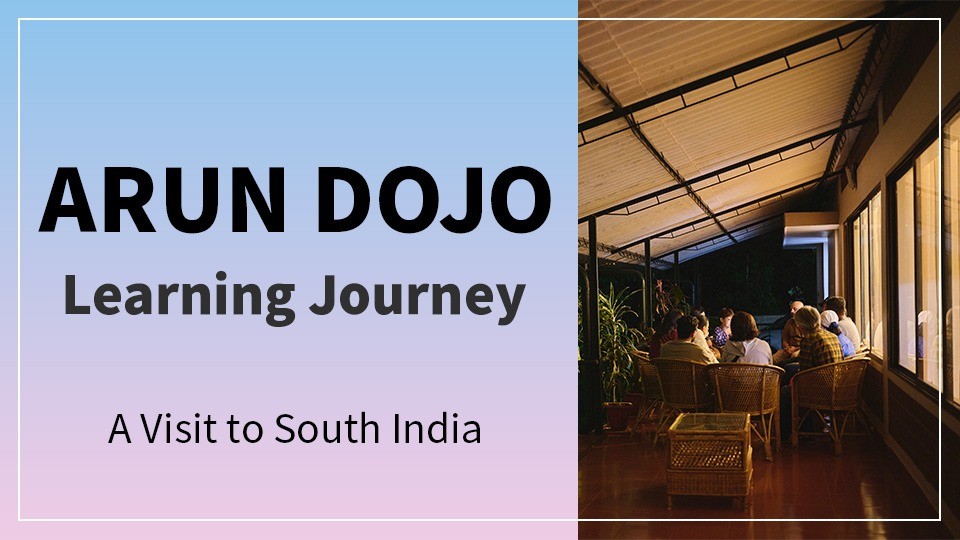
At the end of August, we traveled to South India as part of ARUN DOJO’s “Learning Journey.”
This was our first ever attempt, but it resulted in being an extremely valuable experience, and I’d like to take this opportunity to share my experience among everyone else as well.
First, ARUN DOJO is a platform that aims to be a “place of mutual learning” for social entrepreneurs, investors, and supporters from around the world.*
Since March of this year, we have been engaging in monthly dialogue through an initiative called “Online Sharing”.
The “Learning Journey” is when the entrepreneurs and Japanese participants who had joined online actually meet face-to-face and experience the reality of social entrepreneurship on the ground.
This time, we had a team of 15 people, including organizers. We visited two South Indian startups: Realeleco (formerly Real Elephant Collective) and Stellapps.
At Realeleco, in their field site of the Nilgiris district, we visited not only their office and workshop, but also a local school and hospital that are connected to the specific indigenous community that provided inspiration towards the business.
For Stellapps, we entered their factory and labs on the outskirts of Bangalore, witnessing firsthand the research, development, and manufacturing processes that all occurs behind the scenes.
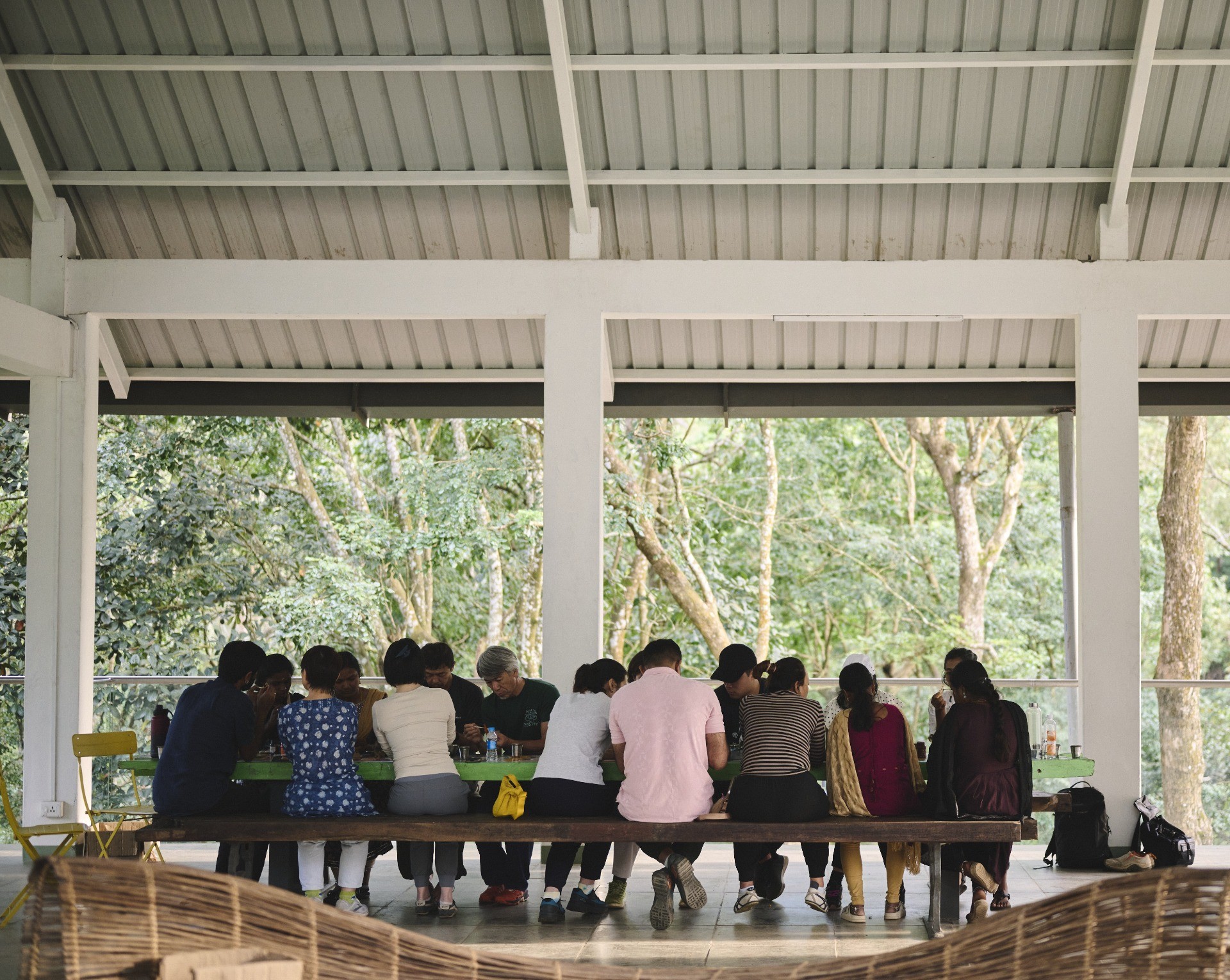
Although we usually learn together online, having one-on-one time in person allowed for deeper mutual understanding and strengthened connections that can also potentially lead to concrete collaborations. Experiencing the field directly—talking with locals, tasting their food, smelling the forest—gave us such a stronger sense of both the social challenges and the passion of the entrepreneurs working hard to address them.
ARUN DOJO will continue. A Learning Journey (possibly under a new name) is already being planned for next year. In early 2026, we also plan to hold an open event in Japan called “Global Knowledge Sharing.”
We will notify you via this mailing list, and we hope you will consider joining us!
(ARUN DOJO is supported by a Toyota Foundation grant.)
— Yusaku Goto, ARUN DOJO Operating Team
3. Talk with an Entrepreneur Who Started an Organic Hemp Business in the Himalayas, Northern India
ARUN regularly holds online events where members can hear directly from entrepreneurs—precious opportunities to gain real insights.
This time, we welcomed Pavitra Joshi, founder of Kumaon Khand, a company that launched an organic hemp business in the Kumaon region of the Himalayas.
Here is a report from ARUN member Mr. Kikata, who attended the session.
Kumaon Khand develops products from hemp seeds grown in the Himalayan Kumaon region.
Their products include textiles, CBD oil for medical use, hemp seeds as a nutritious superfood, and hemp seed oil for skincare—reaching consumers worldwide.
They follow a Seed-to-Store policy: providing consumers with transparency from initial steps of production all the way until the final product, ensuring strict quality control through procedures such as in-house production, and promoting more creative development.
Their philosophy also emphasizes working directly with Himalayan farmers, contributing to community prosperity, and preserving traditions.
Through these principles, Kumaon Khand contributes to the development of Himalayan communities, the preservation of cultural heritage, and the protection of natural heritage.
Pavitra also spoke passionately about the importance of nurturing the younger generation, who will carry India’s future.
By protecting the Himalayan environment, delivering high-quality hemp-based products to consumers worldwide, enriching local communities, and cultivating young people, Pavitra’s Kumaon Khand is truly an inspiring company.
Website: https://www.kumaonkhand.com/
4. Participant Report from the Business Competition “CSI Challenge 6” Report Session
Hello, this is Nakamoto, an ARUN member.
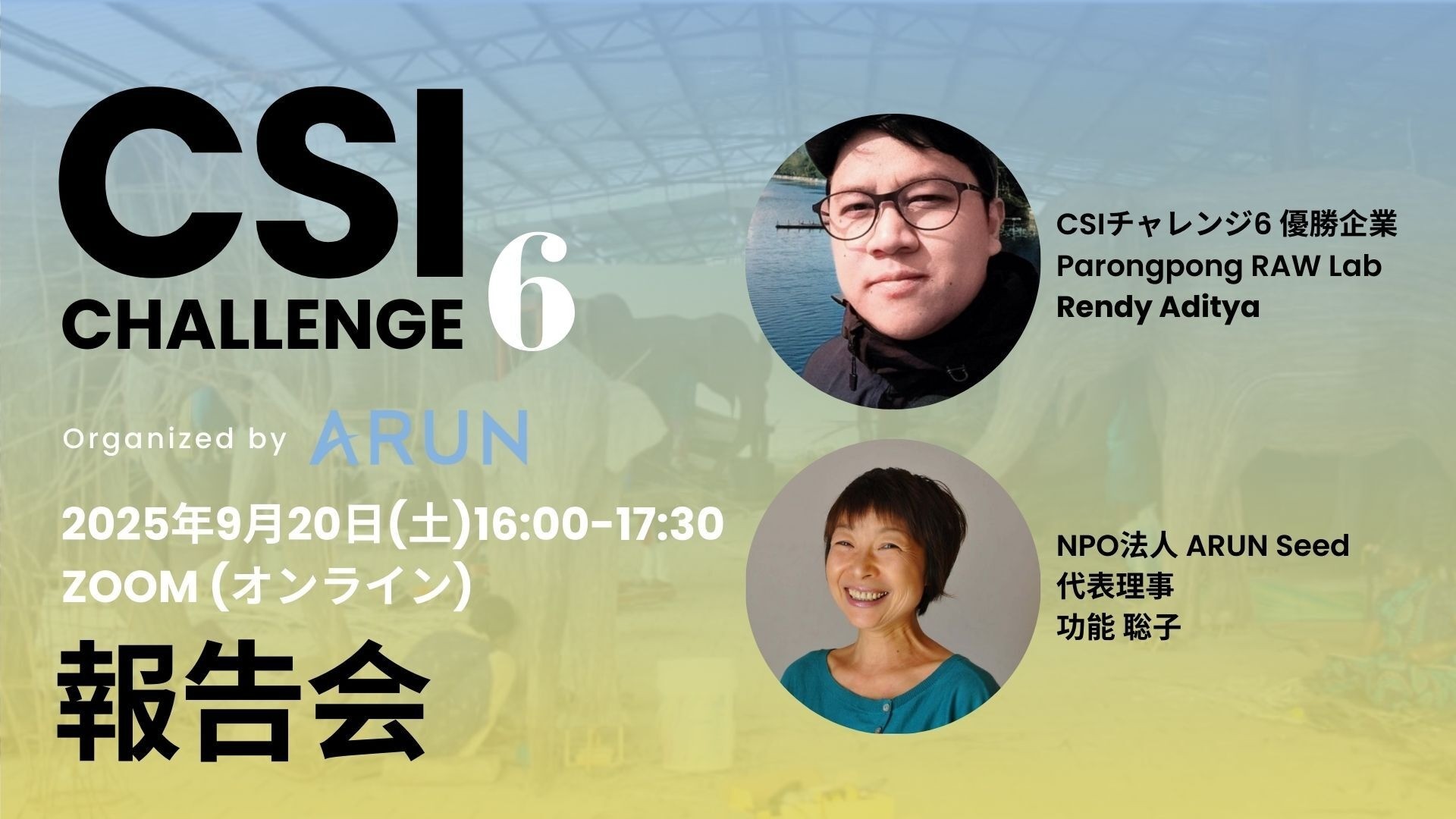
On Saturday, September 20, I joined the online report session for CSI Challenge 6.
CSI Challenge 6 was a business competition held from February to May this year on the theme of biodiversity, attracting 103 applications from 64 countries.
The session included an overview of the competition, introductions to participating companies, and a presentation and Q&A by Rendy Aditya Wachid of Parongpong RAW Lab, which won the grand prize.
Rendy described their initiative to collect discarded fishing nets and recycle them using hydrothermal technology into lightweight, easy-to-use building materials. This not only protects vital marine ecosystems like coral reefs but also provides employment and income opportunities for fishing communities.
What struck me most was how they turned waste into a competitive advantage: by using discarded nets as raw materials, they drastically reduced procurement costs. By locating factories near collection sites, they cut transport costs, allowing them to sell at one-sixth the price of regular construction materials.
The project also has an educational aspect, raising awareness among fishers about how discarded nets affect the sea and their own livelihoods. Collecting nets itself creates jobs, too.
In the future, they aim for fishing community members to participate not just as employees but as owners of micro-factories, giving them ownership and enabling collaboration. This is more than recycling—it’s about improving community life through business.
Finally, Rendy shared a dream vision: “A world where no waste is produced, and future children gaze with curiosity at ‘trash bins’ in museums.” This warm, circular-economy business was born from the desire to leave a better world for future generations.
Rendy’s sincerity and gentle demeanor left a deep impression, making this a heartwarming and inspiring report session.
5. Introduction of the English Newsletter Team
M.K:
Hi everyone, I was born in Japan, but I’ve lived 15 years abroad. I lived four years in New York, then nine years in Hong Kong, and lastly two years in London. I arrived back in Japan last year, and since I attend an international school, I also participate in the English newspaper at my school. Ever since I joined ARUN as an intern, I knew I wanted to utilize my English skills and my interests in newswriting to bring awareness to ARUN, so I’ve started the very first edition of ARUN’s English newsletter!
R.M:
A little introduction about me is that my teammates likewise, I used to live abroad, learning english and interacting with different people from various backgrounds. Specifically, I lived a total of 8 years in Lebanon and America.
My aim as an internship student is to learn how ARUN operates a full working system that supports social entrepreneurs. And in learning about this, I want to contribute to ARUN’s projects by giving whatever resources are available to me right now. I believe my communication/writing abilities via English can go a long way in establishing firm connections with entrepreneurs from all across the globe. I am so excited to kick start my goal with ARUN’s English newsletter!
K.S:
Hello everyone,
Having lived in Japan, France, the United States, and Türkiye, I have had many opportunities to experience different cultures and languages, which has strengthened both my English and my interest in international issues.
In the future, I aspire to become an economist, focusing on reducing global inequality and supporting communities through innovative solutions. I hope to contribute to shaping the next big framework for a more equitable world.
I am very excited to launch this English newsletter and look forward to sharing ARUN’s work with you, while also learning and engaging together through these updates.