
ARUN Newsletter – Issue 10
ARUN Newsletter – Issue 10


Contents
- Facebook Live Report—“A Night of Reflection on the Spirit of Challenge: Social Entrepreneurs Discuss Their Journey of Trial and Error”
- We Asked CSI Members: “What Is a Challenge...?”
- [Facebook Live Report]
ARUN’s ecosystem enriches social business.
CSI Challenge 7 was a business competition designed to encourage entrepreneurs to take on new challenges, but it was also a challenge for the ARUN Seed CSI team that organized it. One such challenge was the Facebook Live event titled “A Night to Reflect on Those Who Take on Challenges: Social Entrepreneurs Discuss Their Journey of Trial and Error,” which was hosted by our interns on June 19.
The video is available on ARUN’s Facebook page, so please check it out.
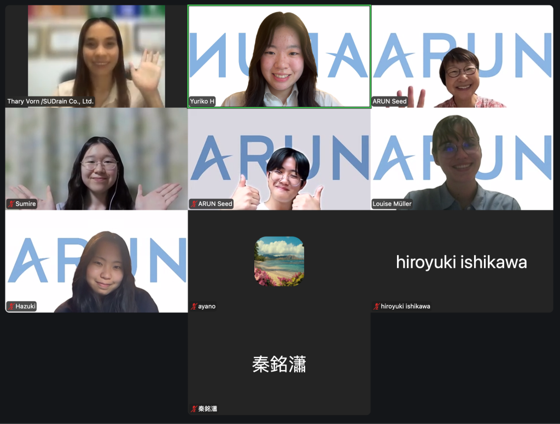
The event was organized by the ARUN Seed intern team, consisting of high school and college students
I may be biased, but it was a really great event.
It’s not just ARUN’s funding—the ecosystem is what makes it so appealing.
Ugyen, the representative of Lanor Creamery—which won the YG Award and a Special Award at CSI Challenge 7—joined us via video, while Thary, the representative of SUDrain—which also won the Grand Prize—joined us live, and both answered questions from our interns.
What the two had in common was their reason for applying to the CSI Challenge 7.
The reasons they cited were:
(1) ARUN supports both solving social issues and business growth;
(2) ARUN provides ongoing support even for businesses that are still unstable.
They said they were strongly attracted not just to the funding provision, but to the fact that an “ecosystem”—connections to people and organizations that support entrepreneurs even after the investment—is effectively in place. He reportedly found it particularly appealing that the “ecosystem”—the network of people and organizations that support entrepreneurs even after the investment, rather than simply providing funding—was functioning effectively.
Loving the “Challenge” Itself, Along with the Solution
There was a common thread in their messages to young people considering entrepreneurship.
It was this: they didn’t start a business because they “came up with a good solution,” but because they were “moved by the social challenge itself.”
Society faces countless challenges. However, there’s only so much one person can solve on their own.
That’s precisely why it’s important to delve deeply into the challenge and understand what you truly want to solve. Both speakers said that if you do that, solutions will naturally emerge.
In other words, they emphasized that “loving the challenge itself deeply” is more important than the solution itself.
No matter how excellent a solution may be, there are various obstacles to actually implementing it in society.
Even new technologies won’t gain widespread adoption without a shift in users’ mindsets. To achieve widespread adoption, creative pricing strategies and capital investment are also necessary. Trustworthy partners and a strong team are also indispensable.
The more you take on challenges, the more new obstacles arise.
And as the two of them explained, what’s needed when you hit those obstacles is an ecosystem like ARUN.
Even challenges that you or your team can’t solve on your own can be addressed when many people are involved in the ARUN pool and share their wisdom, offer support, and provide insights for the next step. Such a sustainable ecosystem is essential for social businesses.
Your Support Is the Ecosystem Itself
The challenges faced by social entrepreneurs may be likened to an oasis or a river that brings life to parched land.
It begins with that first drop—the resolve to confront a challenge—and eventually grows into a mighty current. Along the way, there are floodplains that store nutrients, riverbanks where we pause to look back, bridges that connect people, and boats that carry us forward.
Your support becomes the river, the riverbank, the trees, the boat, and the bridge that sustain these entrepreneurs. At times, it is the stone on the riverbed that slows the current; at other times, it is the bird visiting the water’s edge; and at still other times, it may be a tiny aquatic insect, like a caddisfly, that helps maintain water quality.
Your support fosters the very environment that allows those tackling social issues to continue their efforts over the long term. We need your help to build a sustainable ecosystem for entrepreneurs.
We would be grateful if you could spread the word about this project to as many people as possible and encourage as many people as possible to participate.