
ARUN Newsletter – Issue 4
ARUN Newsletter – Issue 4


Thank you very much for your continued support of ARUN.
We are pleased to share with you ARUN Newsletter – Issue 4, sharing updates from our activities and initiatives.
Contents
1. New Year Greetings
2. The Evolution of Realeleco 's Business Development Now in Book Form!
3. Meeting with ARUN (Mr. Yukiharu Kiho)
1. New Year Greetings
Happy New Year!
Thank you for your continued support of ARUN.
Throughout 2025, we were able to continue our activities thanks to your warm support and cooperation. We express our heartfelt gratitude.
Today, we would like to share our brief reflection on our journey in 2025 and convey our appreciation.
━━━━━━━━━━━━━━
1) 6th CSI Challenge: 103 Companies from 26 Countries Participate
━━━━━━━━━━━━━━
The CSI Challenge, a business competition running since 2016, held its sixth edition in 2025 under the theme “Our Society in Harmony with Nature.”
We received 103 applications from 26 countries worldwide, gathering ambitious ventures tackling environmental restoration and societal renewal through dialogue with oceans, mountains, and local communities.
Grand Prize: Parongpong Raw Lab (Indonesia)
Aims for a world with zero waste, zero carbon build environment, and zero unemployment through the upcycling of abandoned or lost fishing nets (ghost nets). The company name means “zero” in Sundanese. Currently engaged in discussions for investment execution.
Deloitte Tohmatsu Award: Azura Indonesia (Indonesia)
Electrification of small boat engines for small-scale fishermen.
- Excellence Award: Ladakh Basket (India)
- Young Generation Award: Zuffra Solutions (Kenya)
To everyone who supported us, including through crowdfunding, and to our sponsors, thank you so much. We plan to hold the “7th edition” in 2026 and are currently recruiting project members. We hope you will join us. (Please contact us for details.)
━━━━━━━━━━━━━━
2) ARUN DOJO: Crossing Borders, Learning from the Field
━━━━━━━━━━━━━━
ARUN DOJO: Where entrepreneurs, investors, and supporters learn together.
In 2025, with support from the Toyota Foundation, we realized a “Learning Journey” in India.
We visited the sites of past CSI Challenge award-winning companies like Realeleco (formerly Real Elephant Collective) and Stellapps. We were deeply impressed by their history of leaders collaborating with local communities to envision the kind of society they want, building businesses, and driving social change.
Participants gathered not only from Japan but also from across India. Witnessing their shared amazement at on-site discoveries and their exchange of wisdom and experience embodied the very “learning ecosystem” we aspire to create.
[Announcement: Entrepreneurs are coming to Japan in February!]
In February 2026, we plan to invite entrepreneurs from India and Cambodia for a learning journey in Japan, centered around Fukushima. We are also planning an event in Tokyo on Saturday, February 28, 2026. Please come meet them in person! (Details will be announced in the next issue!)
━━━━━━━━━━━━━━
3) Diverse Leadership: 15+1 Years of Progress and the Road Ahead
━━━━━━━━━━━━━━
ARUN, which began with social investment in Cambodia in 2009, marks its 16th year this year. In March 2025, we took time to reflect on our journey with everyone who has been involved so far.
Today, ARUN is active with a diverse membership ranging from high school students to those in their 70s. Thinking about ARUN’s community, I recall a passage below written by Motoko Obinata in her book The Textbook of Natural Leadership:
- “...Within a herd of horses, the hierarchy is not fixed. It is said that the horse possessing the most relevant information for the situation and environment at that moment will demonstrate leadership.”
I feel that ARUN is now becoming a place where this kind of “leadership” is embodied. Rather than one person pulling everyone along, everyone shares their wisdom and thoughts according to the situation, working together to create a better society. I sincerely hope we can continue walking this path together with all of you, aiming for such a society.
I look forward to your continued support in 2026.
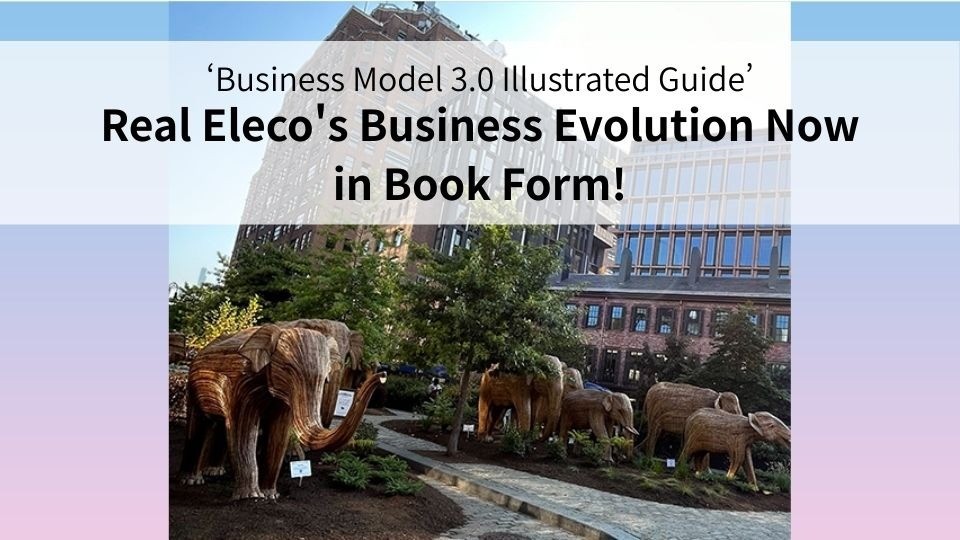
2. Real Eleco's Business Evolution Now in Book Form!
ARUN Seed portfolio company Realeleco's business model is featured in a new book. Realeleco (brand name: The Elephant People) will be included in the ‘Business Model 3.0 Illustrated Guide’, available for pre-order starting December 23, 2025.
Here's a glimpse into how Realeleco has created social impact.
[Visualizing Business Models with ‘Bizgram’]
The business models of companies receiving impact investment may be relatively new and complex. Built on principles like “benefiting all three parties,” it indicates the three necessary core layers of business: the buyers, sellers, and society. It can sometimes be difficult to see who those three parties are and what is being transacted. However, the ‘Bizgram’ proposed by Zukai Institute, Inc. offers a versatile solution, one that visualizes and simplifies complex business relationships, making them understandable to anyone. The ‘Business Model 3.0 Illustrated Guidebook’, which examines the business relationships of 50 companies using Bizgram, will feature Realeleco, an ARUN Seed portfolio company, and its business model. While Diagram Research Institute has already published the ‘Business Model 2.0 Illustrated Guidebook’, this new 3.0 edition focuses on visualizing the patterns of change that became key to corporate growth. We covered the meeting between Realeleco and Diagram Research Institute, facilitated by ARUN Seed.

Figure: What is Bizgram? (From Diagram Research Institute website)
【The Founders of Realeleco】
With the successful completion of their U.S. tour featuring life-size elephant sculptures displayed across various locations, Realeleco is receiving significant acclaim today. However, they weren't always creating elephants from the start. In the early days, they continuously experimented with whether their lantana creations could gain market value. However, the four founders turned these challenges into opportunities, flexibly and persistently. ARUN Seed's investment team holds monthly meetings with them, and these discussions reveal their sincere character and passionate dedication.
The founders' parents migrated to this region from other parts of India to improve the lives of the indigenous people here and help them reclaim their rights and pride. This means the founders themselves are second-generation activists raised within the indigenous community. As second-generation activists working alongside indigenous artisans, the founders of Realelco are not only building a sustainable enterprise, but also continuing a legacy- transforming cultural identity, environmental responsibility, and social justice. They strive for a model of change.
【What Changed Them】
Realeleco's base of operations is in the forests of the Nilgiri Hills in South India. Nilgiri means “blue mountains.” It is said this name originates from the mountains appearing blue when the slopes are blanketed by blue flowers that bloom only once every twelve years. The Nilgiri Hills are designated a UNESCO Biosphere Reserve for their rich biodiversity. Imagine an area with a population density comparable to that of cities like Nagano or Asahikawa, where 150 elephants live in herds within forests near human settlements.
Multiple indigenous groups also live there, primarily people who have traditionally gathered honey and hunted, alongside others who have lived in the foothills, mainly farming. Stories have been passed down among these indigenous peoples—some about those who cared for the elephants, and others about those who drove them away. For them, the relationship with the wildlife present has been shaped over a long history.
However, when the Nilgiri Hills were designated as national parks and protected areas in the 1980s, the indigenous people lost their means of living locally and were forced to work in urban areas and plantations. Soon, the Nilgiri Hills became overrun with invasive alien species, environmental degradation worsened, and wildlife, such as elephants, increasingly ventured into villages, causing serious conflicts with people.
The four founders of Releleco (formerly called The Real Elephant Collective) also earned their income outside the region before starting the project. Yet, it was likely the indigenous people's philosophy of Coexistence—their hope for living together—that supported their entrepreneurial venture.
【What They Changed】
Reading Bizgram clearly shows how they transformed society's “accepted norms” and “inevitabilities.” While the book details everything, here's one key point for newsletter readers:
One common-sense change they made was the rule that “nothing should be taken out of protected areas.” The Indian government isn't alone in prohibiting the removal of all items from national parks and protected areas. Japan also has the concept of “Iriai rin” (communal forests), yet it fundamentally prohibits taking anything from state-owned forests. However, they changed that rule, successfully utilizing invasive alien species as their resource and eradicating them.
【Their Future】
They create wooden sculptures modeled after the animals of the Nilgiri Hills. The wood used as raw material is a leguminous tree called Sena, an invasive species with strong reproductive capabilities, similar to lantana. Their collection includes endangered animals found only in the Nilgiri Hills. Like the elephant sculptures, each piece is carved by indigenous artists after observing real animals.
Take a look at their Instagram. We are instantly drawn into the forests of the Nilgiri Hills. Wooden animal sculptures you can pick up and play with, along with beautiful cards featuring animal illustrations, are displayed as if sprouting from the wood like mushrooms. Founders Tarik and Subhash say they want to display their work “like mushrooms,” rather than neatly arrange it on museum shelves. Mushrooms also serve as a metaphor for ecosystems. They appear to emerge by chance, shaped by overlapping factors like nutrient levels and disturbances, yet they are fundamentally “meant to be there.” Extending this metaphor, we see their own existence and the beautiful nature of the Nilgiri Hills—shaped by their connection to flora and fauna—overlapping and becoming visible.
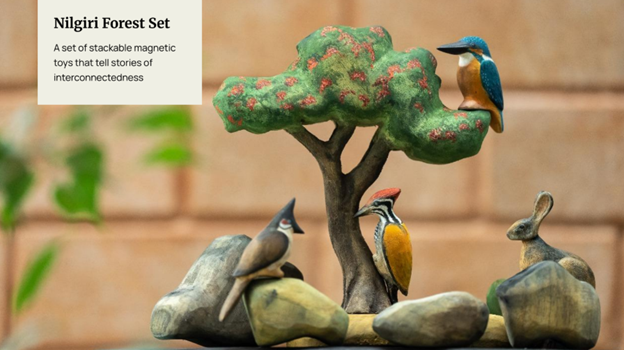
Photo: Set depicting the Nilgiri forest (courtesy of Realeleco)
While they are an art collective, they are also excellent community managers. What became clear during meetings with the investment team is that they aim to keep the organization as flat as possible. While there are leaders, they describe it less as a structure in which one person unilaterally commands others and more as roles that naturally emerge from mutual support. To remain a creative space for people who wish to live amidst the rich nature of the Nilgiri Hills, they likely believe it's essential to provide a workplace where everyone involved with the brand can feel secure. Their manner of speaking conveys a sense of trust that ARUN's funding and ongoing support are provided on the basis of a shared understanding of these values.
●『Business Model 3.0 Encyclopedia』scheduled for release on January 26.
Free preview available on note starting December 23
note Business Model 3.0 Encyclopedia
https://note.com/bizgram/n/
● [Tarik, One of Realeleco's Founders, is Coming to Japan]
Tarik will be visiting Japan as part of the ARUN DOJO program. An event is scheduled for Saturday, February 28, 2026. We encourage all readers to attend and hear Tarik speak directly.
Details coming in the next issue!
● Their thoughts and work processes are featured on Instagram.
Instagram
https://www.instagram.com/
● Request to newsletter subscribers: Please share any opportunities to exhibit or carry their work (e.g., museum gift shops, corporate gifts).
ARUN Seed Contact
https://www.arunseed.jp/
3. Meeting ARUN (Mr. Yukiharu Kiho)
What led our supporters to discover ARUN?
In this series, we invite them to share their personal stories—how they encountered ARUN and how it touched their lives—in their own words.
This time, we present a message from Mr. Yukiharu Kiho, who supports ARUN's activities in many ways.
----------------------------------
Have you heard of the movie “It Rains in Santiago”?
In September 1973, Chile's Allende government collapsed following a military coup led by General Pinochet. Chile then fell under the control of a military regime headed by General Pinochet. At the time, Jose, a chemist conducting research at the University of Chile—Chile's top university—barricaded himself inside the university campus and fiercely resisted the military regime. Despite his resistance, Jose was ultimately expelled from Chile by the government. Jose was accepted by the French government as a UN refugee and continued his research in France.
I met Jose at a university in the French countryside. Our friendship deepened, but at the time, I couldn't grasp the weight of his fate as an exile and failed to fully understand Jose's feelings each day. Then one day, Jose showed me his passport. It wasn't his Chilean passport; it was a refugee passport issued by the United Nations. As he showed me that passport, he spoke to me about his parents, siblings, and girlfriend back in Chile. The look in Jose's eyes as he spoke held deep sorrow, yet it was also a gaze of immense strength, facing his fate head-on. And it held an incredibly powerful love for his homeland.
My true encounter with the world began on this day.
Forty years later, at ARUN, I was invited by Ms. Kono and met young social entrepreneurs from many countries, including India, Indonesia, and Cambodia.
Listening to the entrepreneurs' passionate stories, I found myself unconsciously searching for Jose's gaze. And in the entrepreneurs' eyes, though the times differed, there was a shared sparkle—a light born of their love for their own countries.
The entrepreneurs I met through ARUN also shared with us their beautiful feelings for the homelands they had lived in.
Wonderful ARUN friends. I want to expand our global circle of friends even more!